Statement of financial position - why 3 columns?

I have Googled this and cannot seem to get a straight answer - or a lot of answers at all to be honest. Could someone explain clearly what the logic is of the 3 columns on the statement of financial position?
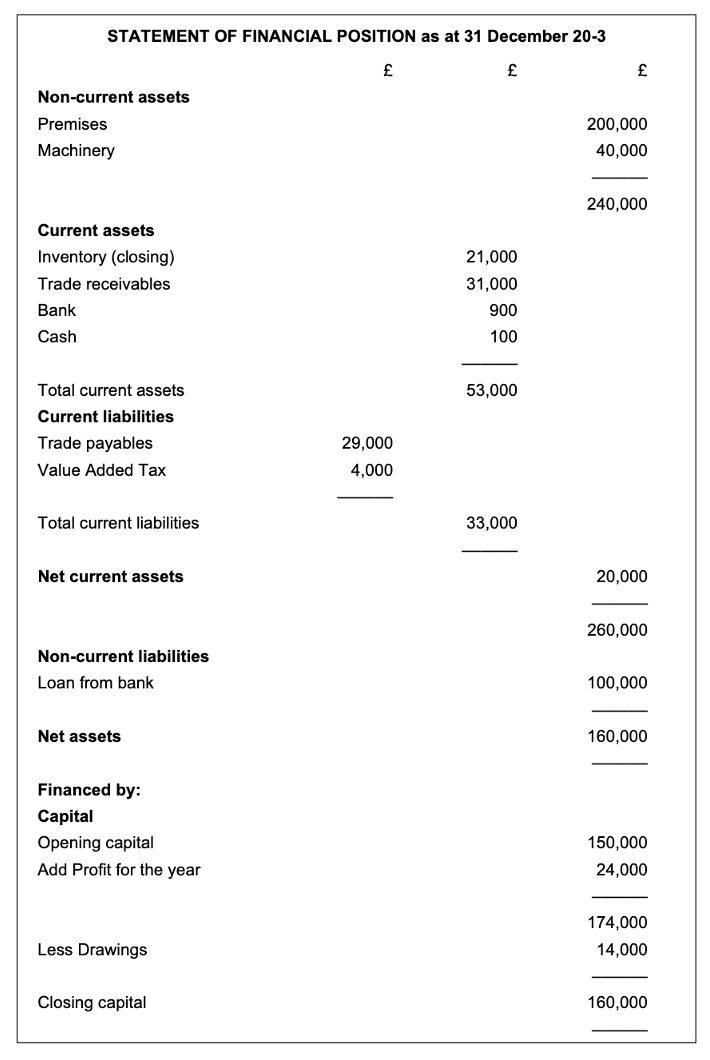
I don't understand why some calculations are made in column 1, some in column 2 etc. I sort of can tell that the third column is for the main totals but there just doesn't appear to be any rhyme or reason or an explanation in my studies as to why the calculations are spread across the three columns...? I would really like to understand this, as all of my calculations are correct, I just don't know which columns to put the figures in..!
Thanks in advance!
Comments
-
The balance sheet is the statement of financial position. Their equation is assets minus liabilities equals capital. Assets is what the business owns (1st part), 2nd is what the business owes (liabilities) and the third part is the capital (basically what the firm is worth.)
The calculations and words can change from firm to firm depending on what they operate in and the sector.
But this is a demonstration.
For example, the NCA, I could add motor veg holes. For the current asset I could add prepayments. Fir the current liabilities I could add accruals.
You should be given options in the exam as to what to put, and you should be able to recognise which one is which.
If you are unsure about the calculations I can explain them.
I hope I have answered your question somewhat. But if I haven’t0 -
I don't know if this comment was meant for another post as it doesn't really tie in to what my question was? I appreciate you answering though. I was asking why there are 3 columns on the balance sheet and how you decide which parts go where?anony123 said:The balance sheet is the statement of financial position. Their equation is assets minus liabilities equals capital. Assets is what the business owns (1st part), 2nd is what the business owes (liabilities) and the third part is the capital (basically what the firm is worth.)
The calculations and words can change from firm to firm depending on what they operate in and the sector.
But this is a demonstration.
For example, the NCA, I could add motor veg holes. For the current asset I could add prepayments. Fir the current liabilities I could add accruals.
You should be given options in the exam as to what to put, and you should be able to recognise which one is which.
If you are unsure about the calculations I can explain them.
I hope I have answered your question somewhat. But if I haven’t0 -
What do you mean three columns? Assets, liabilities and capital? Also, you should be able to tell which one goes where, as this can change from business to business. In the exam you should have a drop down list which makes it easier for you.0
-
If that doesn’t answer your question, then I am unsure what you exactly mean.0
-
I really don't understand what you are saying, sorry, we must be speaking cross-purposes.anony123 said:If that doesn’t answer your question, then I am unsure what you exactly mean.
I am asking, the photo I uploaded showing a statement of financial position has 3 columns (with £ signs). You are saying the three columns relate to assets, liabilities and capital?
If that is the case, why are the non-current assets recorded in the 3rd column, current assets in the 2nd column, current liabilities in the 1st? You then have net-current assets, non-current liabilities, net assets, and then 'financed by' all in the 3rd column? I could understand what you were saying if you said column 1 was for recording assets, column 2 was for recording liabilities, and column 3 was for recording capital, but that isn't what the image I uploaded shows...there does not seem to be a logical pattern for what column to put things in and I would like to know for my exams otherwise I am just simply guessing.0 -
@pauldbaker95 That’s fine. I don’t fully get what you mean. I’m sure somebody else in the chat can explain your question better. Sorry if I confused you more.0
-
Hi @pauldbaker95
I hope you are well
With regards to 3 columns, that is usually a detailed balanced. Most companies will prepare a balance sheet with 2 columns comparing the previous year and current year. Some balance sheets may have columns based on their Debit or Credit position. But I have provided a link below which may help you with the answer as to why there is 3 columns
http://jeffboulton.ca/BAF 3M1 Note - Balance Sheet.htm
Generally balance sheets in most businesses will have a comparison in prior and current, it's only some that will use detailed balance sheets.
Hope this helps
Kind regards
Shamil0 -
Thank you for your help anyway, I appreciate it.anony123 said:@pauldbaker95 That’s fine. I don’t fully get what you mean. I’m sure somebody else in the chat can explain your question better. Sorry if I confused you more.
0 -
Ah I see, I think this is what I was looking for. The diagram on the link really helps. Thank you.shamilkaria said:Hi @pauldbaker95
I hope you are well
With regards to 3 columns, that is usually a detailed balanced. Most companies will prepare a balance sheet with 2 columns comparing the previous year and current year. Some balance sheets may have columns based on their Debit or Credit position. But I have provided a link below which may help you with the answer as to why there is 3 columns
http://jeffboulton.ca/BAF 3M1 Note - Balance Sheet.htm
Generally balance sheets in most businesses will have a comparison in prior and current, it's only some that will use detailed balance sheets.
Hope this helps
Kind regards
Shamil0 -
0

